Car Scanner App: Complete Vehicle Analysis
Announcements
A car scanner app has completely transformed how you diagnose vehicle problems.These apps connect to your car’s on-board computer, providing real-time data on engine operation, transmission and emission systems.
Announcements
The technology behind these tools has evolved significantly, moving from simple error code readers to sophisticated platforms with advanced analytics.If you want to understand how to extract the maximum potential from an automotive scanner and apply strategies that go beyond the basics, read on to find out how to optimize your vehicle diagnostics.
The Basic Functioning of a Car Scanner
A scanner app works by connecting to your car’s electronic control unit (ECU) via a Bluetooth or WiFi adapter.This adapter connects to the OBD-II port, a standard connector present in virtually all vehicles manufactured after 1996. Once connected, the app accesses data stored in the system, allowing you to view detailed information about engine performance and identify problems before they become costly.
The communication protocol used by modern scanners follows international standards, ensuring compatibility with various vehicle models. When you open a car scanner app, the first action is to pair with the adapter, which sends signals to the ECU requesting specific data. These data return to the application, which decodes them and presents them in understandable format, from RPM readings to instant fuel consumption.
Advanced Strategies for Vehicle Diagnosis
Many users use scanners only to read error codes, a limited approach that leaves to discover enormous analytical potential. To optimize your experience, you must implement continuous monitoring of specific parameters, establishing normal baselines for your vehicle and tracking deviations over time. This strategy allows you to identify gradual degradation of components before critical failures occur, saving on emergency repairs.
Comparative analysis is an advanced technique rarely explored by car owners.You can record data in different driving conditions (acceleration, constant speed, urban traffic) and compare them to identify specific anomalies.For example, if fuel consumption increases only in certain situations, this may point to problems with injectors, oxygen sensors or turbo management, information that a simple error code would not reveal.
Real-Time Data Optimization
A truly optimized car scanner app allows customization of which parameters you monitor simultaneously. You do not need to view all 200+ available variables, only those relevant to your specific diagnosis. By setting up customized dashboards for different scenarios (pre-travel verification, consumption monitoring, specific fault diagnosis), you save time and increase the accuracy of your analyses.
Historical data recording is a feature that differentiates basic scanners from professional platforms.When you record complete driving sessions, it creates a record that allows retrospective analysis and comparison with future diagnostics.This approach is particularly valuable for intermittent problems, which are difficult to diagnose in a single session, but reveal patterns when analyzed in multiple records.
Error Codes and Professional Interpretation
Not all error codes indicate serious problems, but you need to know how to distinguish between warnings and critical faults. A quality car scanner app offers contextual interpretation of the codes, explaining not only what the error means, but also what components may be involved and what the level of urgency for repair. A P0171 code (Very poor system), for example, can result from dirty oxygen sensor, air leakage in the input multiple or clogged injector.
The advanced strategy here is to not only rely on the standard code description, but to use complementary data for narrowing down the diagnosis. You can check the engine temperature, reading specific sensors and history of how this code manifested to make a more accurate analysis. Some applications offer AI-powered diagnostics that analyze multiple parameters simultaneously, providing probabilities of which component is really in trouble.
Preventive Monitoring and Predictive Maintenance
Traditional preventive maintenance follows fixed schedules, but you can evolve to predictive maintenance using data from your scanner. By monitoring the rate of deterioration of specific parameters, you predict when a part will need replacement, not when the manufacturer says it should. This approach reduces costs, prevents unexpected failures and extends the life of your vehicle significantly.
A practical example: instead of changing oil every 10,000 kilometers, an app scanner can help you monitor oil viscosity through indirect readings and operating conditions.If you mainly perform City driving with multiple stops, your engine may cool down inadequately, accelerating oil degradation, justifying more frequent changes.On the other hand, if you drive mainly on highways, you can extend the intervals safely, saving significantly on maintenance.
Integration with Vehicle Data Platforms
Modern scanners applications do not work in isolation, but integrate with vehicle management platforms that you can access via the web or mobile. This integration allows automatic data synchronization, organized historical access and statistical analysis that reveals trends over months. You can export reports, share diagnostics with mechanics and even integrate data with GPS tracking systems for location-related performance analysis.
True optimization involves choosing a platform that offers an open API or native integration with other systems you use. If you manage a fleet, for example, you can automate the collection of data from multiple vehicles, generate automatic alerts when parameters go out of whack, and even integrate with scheduling systems for automatic preventive maintenance.
Advanced Troubleshooting Techniques
When you face a specific vehicle problem, a car scanner app offers much more than just confirmation than you already know. Advanced techniques include failure pattern analysis, where you examine when code appears (cold vs. hot, acceleration vs. deceleration), failure duration, and frequency. This information helps rule out possibilities and focus on specific diagnostics, saving time and money in the workshop.
Comparison with similar vehicles using crowdsourced data is another powerful technique rarely explored.Some platforms maintain databases of common problems reported by users of the same model and year, showing what rate of occurrence each problem has. If you are diagnosing a rare problem in a specific vehicle, knowing that 87% of users of that model with that specific code have had valve command sensor failure is valuable information that speeds up the diagnosis.
You can also implement isolated tests through your scanner, such as activating different solenoids or systems to observe response. This ability to interact with car systems goes beyond passive data reading, allowing active diagnostics where you check if specific components respond to commands correctly. Not all apps offer this functionality, so look for platforms that support two-way control with your ECU.
Time chart analysis is critical for advanced diagnosis.When you plot as a parameter varies over time during a driving session, you can identify instabilities that would be imperceptible by looking only at the current value.A sensor with oscillating reading can indicate poor contact, sensor degradation, or electronic problem before it fails completely, allowing for accurate preventive maintenance.
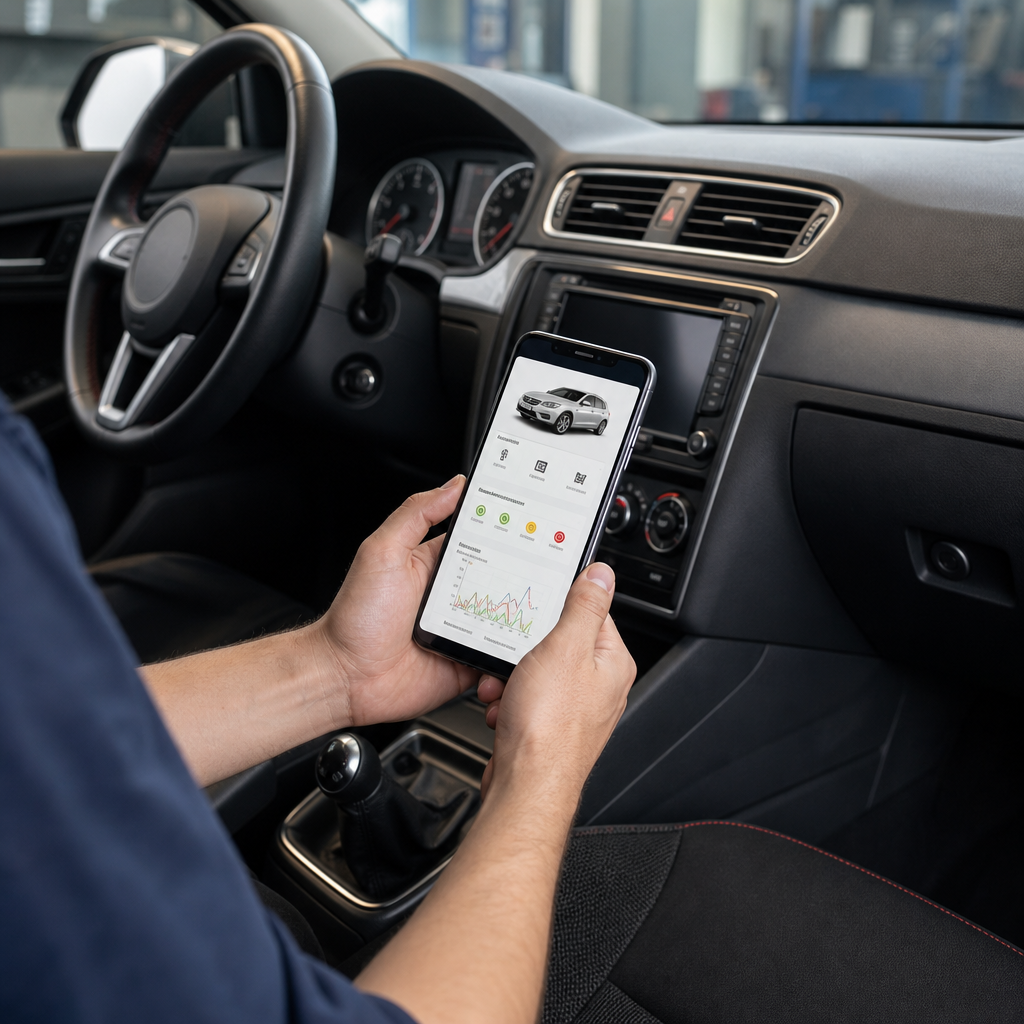
The correlation between multiple parameters offers deep insights.You can simultaneously visualize how fuel pressure, fuel injection, air intake and engine temperature vary together during different phases of operation.If fuel pressure drops significantly when the load increases, you quickly identified a problem in the fuel pump that a less experienced user could miss by analyzing isolated parameters.
Selecting and Configuring the Best Scanner for Your Needs
Not every car scanner app is suitable for your specific needs, so you should consider several factors when choosing. If you only own a passenger vehicle and want basic diagnostics, a free app with a generic OBD-II adapter may be sufficient. However, if you want to take advantage of advanced strategies mentioned in this article, you need a premium platform that offers real-time monitoring, data recording, advanced analytics, and ongoing support.
Compatibility is crucial and you should explicitly check whether the scanner supports all OBD-II protocols (ISO 15765, ISO 14230, ISO 9141-2, SAE J1850). Some adapters only support specific protocols, creating incompatibility with certain vehicles. You should also consider whether the application supports data specifically related to your model, as brands such as Tesla, BMW and Audi use proprietary systems that require specialized scanners.
The application interface matters more than you think for workflow optimization. A good scanner offers dashboard customization, shortcuts to frequent functions, and intuitive visualizations that you quickly understand.If you spend hours looking for where a functionality is or struggling with a confusing interface, you are losing efficiency. Testing trial version before purchasing premium ensures that you choose a platform that works with your work style.
Technical support and community around the platform are differentiating factors. An app scanner with active forum, regular updates and responsive support allows you to quickly solve problems and learn advanced techniques from other users. You will find tutorials, customized scripts and solutions to specific problems that accelerate your learning and maximize the potential of your investment.
Practical Use Cases and Measurable Results
To understand the real value of a car scanner app, consider practical cases where this technology saved time and money. An owner with an abnormally high fuel consumption vehicle used the scanner to continuously monitor injection parameters, finding that fuel pressure fluctuated irregularly during acceleration. This pointed to a fuel pump with inconsistent flow rate, a problem that would be diagnosed only after multiple expensive visits to the workshop without the scanner.
Another example involves early identification of problems in the emission system. Monitoring O2 sensor readings over several weeks, a user noticed gradual degradation that did not yet trigger error codes, but indicated sensor close to failure. Replacing the sensor proactively, it avoided future fault code, possible failure in emissions testing and much higher cost of diagnosis. These cases demonstrate that real value goes far beyond simple code reading.
For fleet owners or enthusiasts working on multiple vehicles, the ability to compare data across units provides insight into design issues or wear patterns specific to certain production lines.A scanner connected to a management platform allows you to identify which vehicles in a given lot have similar problems, facilitating voluntary recalls before they become safety or reputation crises.
Integration with telemetry also offers measurable economic benefits. Acceleration, braking and speed data reveal inefficient driving patterns that increase fuel consumption, tire wear and engine stress.With this information, you implement behavioral changes that significantly reduce operating costs, especially if you manage a fleet where these small gains multiply by hundreds of vehicles.
Predictive analytics offers measurable return through reduced unplanned downtime.When you anticipate failures through consistent monitoring, you can schedule maintenance at convenient times instead of facing unexpected breakdown in the important travel medium.For businesses, this translates into reduced emergency repair costs, which are often 2 to 3 times more expensive than planned maintenance.
You will also find savings through more accurate diagnosis before leading to the mechanic. Instead of letting the professional perform costly diagnosis and possibly replace components unnecessarily, you provide accurate data on what the problem is. This speeds up repair, reduces labor and avoids replacement of parts that do not need to be changed just because the technician had no confirmed diagnosis.
Limitations and Important Considerations
Despite the significant benefits, you should understand that a car scanner app has clear limitations that should not be ignored. Scanner access is limited to the data the ECU stores and shares, meaning that not all vehicle information is available. Pure mechanical problems such as distribution current wear or suspension clearance do not generate electronic codes and therefore do not appear on the scanner, requiring traditional physical diagnosis.
Interpretation of data requires significant technical knowledge to be truly useful. An error code is only an indicator, and its root cause requires contextual analysis that goes beyond what the application can automatically provide. You can have multiple possible causes for the same code, and choosing the right cause requires understanding of how the system works. AI applications help by providing probabilities, but definitive diagnosis often still requires experienced mechanics.
Safety is also an important consideration when you connect your device to the vehicle’s electronic system through an app. Low-quality adapters or unreliable applications can potentially damage the ECU or expose location data and driving behavior. You should only use certified adapters from reputable manufacturers and established developer applications with a proven safety history.
Updates to your smartphone’s operating system and changes in data legislation also affect functionality. An app that worked perfectly may become incompatible after iOS or Android updates, requiring you to keep in touch with a developer for compatible updates.In addition, regulations on telemetry data collection change frequently, and you should be aware of what data is being collected and how it is being used by the platform.
Finally, relying too much on scanner data can lead you to ignore important physical signals from the vehicle, such as abnormal noises, vibrations or smells. A vehicle transmitting normal information through the scanner but making strange noise still has a problem that requires investigation.