A car scanner app acts like a digital mechanic in your pocket, connecting to your vehicle’s on-board computer to identify problems before they see anything serious.
Announcements
Vehicle diagnostic technology has evolved a lot in recent years, and today there are applications that offer impressive functionality for owners who want to maintain full control over their cars. With an automotive scanner on mobile, you receive alerts about failures, save time on diagnostics and make smarter decisions about maintenance.
How a Car Scanner App Works
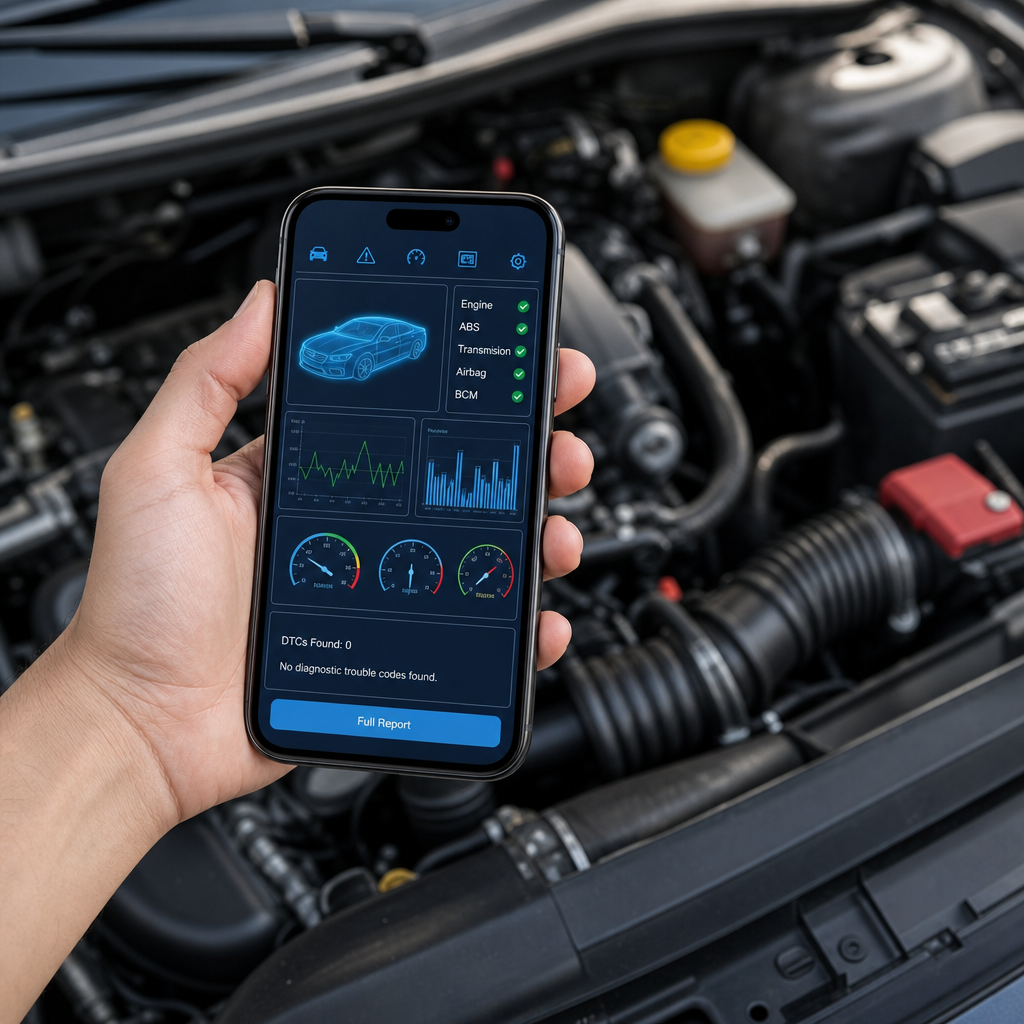
The application communicates with the engine control unit through an OBD-II adapter, a small device that connects to the diagnostic port of your vehicle, usually located below the steering wheel. This adapter translates the car data into understandable information that appears on your phone screen, allowing you to see fault codes, engine temperature and fuel consumption in real time. The process is simple: insert the adapter, open the app on the mobile phone and establish the connection via Bluetooth.
Each automotive scanner accesses the data through a standardized protocol, known as OBD-II, which all cars manufactured after 1996 must have. The app works by interpreting the signals from the on-board computer and displaying information about emissions, performance and engine components. You can immediately see if there are any problems, from a loose fuel cap to more complex failures in the injection system.
Main Features of an Automotive Scanner
A good scanner app offers much more than just reading error codes.You have access to detailed information such as engine RPM, coolant temperature, car speed, fuel pressure and instant gasoline or diesel consumption.This variety of data allows you to better understand the behavior of your vehicle and identify abnormal patterns before they turn into serious problems.
Fault code cleaning is an essential feature that saves you going to the workshop to reset the “Check Engine” light after solving a minor problem.In addition, many apps allow data history, recording all readings so that you can track the evolution of car health over time. Some advanced scanners also offer manufacturer-specific diagnostics, interpreting proprietary codes from brands such as Volkswagen, Ford and Fiat that do not appear in generic diagnostics.
Essential Checklist: What to Check With An App Scanner
You should regularly use your automotive scanner to monitor critical points of your car and avoid unnecessary expenses.Check out this handy checklist that works for any homeowner who wants to keep track of preventive maintenance.
Start by checking the engine temperature regularly during normal driving. If the temperature exceeds 100°C, you may be experiencing problems with the cooling system that need immediate attention.Monitor also the fuel pressure, which should be within the parameters specified by your vehicle manufacturer, usually between 3 and 6 bar depending on the model.
Analyze instant fuel consumption while driving at constant speeds. A sudden increase in consumption indicates problems with spark plugs, filters or injection that must be investigated. Check fault codes whenever the “Check Engine” light appears, even if the car appears to be running normally, as some silent faults may damage the catalyst.
Track the injection time and spark duration of the spark plugs, data that reveals how the engine is set. Monitor the voltage of the battery at rest (it should be between 12 and 13 volts) and during the start-up, indicators of problems in the electrical system. Regularly check the air flow entering the engine, especially if you notice difficulty in starting or lack of power during acceleration.
Examine the emission codes that arise, signs that the gas treatment system may be compromised. Monitor the voltage of the oxygen sensor, vital component for fine-tuning the air-fuel mixture. Also check the throttle valve opening and the injector duty cycle, data that helps diagnose problems before they become expensive.
Track the lambda probe voltage history over time as abnormal variations indicate issues in the emission system. Regularly check for new codes after solving a previous problem, confirming that the fault has actually been eliminated. Use the scanner to monitor the catalyst yield, expensive part that can be damaged by uncorrected engine failures.
Advantages of Using an App Scanner Regularly
Preventive maintenance with an app scanner significantly reduces your repair costs because you identify small problems before they escalate into larger, more expensive damage. A malfunctioning oxygen sensor, detected early, costs a fraction of what a damaged catalyst costs, so the investment in a scanner pays off quickly.
You gain autonomy and knowledge about the operation of your car, leaving to rely exclusively on the mechanic to understand what is happening with the vehicle. This real-time information allows you to make smarter decisions about repairs, negotiating with workshops more safely because you already know what the problem really is. The scanner app is also excellent for detecting intermittent problems that are difficult to diagnose even in a specialized workshop.
Safety increases because you will never be caught off guard by a serious fault that could leave the car broken on the road. Many owners save waiting time in workshops, identifying fault codes on their own and looking for the workshop only when really necessary.In addition, you will have historical records of all car maintenance, valuable information for resale or to prove that the vehicle was well maintained.
Types of Scanners and Which to Choose for Your Car
There are basically three types of scanners on the market: generic ones, which work with most cars by reading standard OBD-II codes; brand-specific scanners, which access proprietary information from manufacturers like Mercedes and BMW; and premium scanners that offer advanced component testing and diagnostics.
For home use in a popular car like Chevrolet, Fiat or Volkswagen, a generic scanner with Bluetooth adapter is totally sufficient and costs between R $ 50 and R $ 150. If you have an imported car or premium brand, invest in a brand-specific scanner is worth it, as it offers information that generics can not access, allowing much more accurate diagnostics. Premium scanners, which cost from R $ 500 to R $ 2000, are recommended only if you work with car repairs or need professional features such as parameter recording and component reprogramming.
Compatibility is crucial: before buying, make sure the adapter works with your specific vehicle by referring to the manufacturer’s compatibility list. Your phone’s operating system also matters, as some apps work only on Android while others work on iOS. Look for reviews from users who have the same car model as you, as practical experience is the best indicator of quality and compatibility.
Limitations You Need to Know
Although powerful, an app scanner can not repair anything by itself, it just diagnoses and informs, so you will still need to take the car to a mechanic for the repairs themselves. Many fault codes require additional physical tests that the app can not do, such as measuring resistance of components or testing voltage at specific points of the car. The interpretation of some proprietary codes can be complex, requiring in-depth technical knowledge that not every ordinary owner has.
Some intermittent problems may not be caught by the scanner if they do not occur while you are monitoring the car. Very old cars, prior to 1996, do not have the OBD-II port and therefore are not compatible with these apps. Low quality adapters can provide inaccurate readings that lead you to wrong conclusions about the state of the car, so buying from trusted brands is essential to get reliable results.
Your phone’s battery charges quickly during extended monitoring sessions, especially if Bluetooth is continuously turned on, so you may need a portable charger. Some apps charge monthly or yearly subscriptions to access advanced features, so research pricing policies before installing. Finally, faulty sensor information can give abnormal readings, so it’s important to validate the information with physical tests or consult a mechanic before making repairs based solely on the app’s data.
Practical Tips to Maximize Your Scanner Use
Develop the habit of taking regular readings from your scanner in similar conditions, such as driving on the same route at similar times, so you can establish normal patterns and identify anomalies easily. Record the readings in a notebook or digital file, noting the date, mileage and values of each important parameter, creating a history that you can consult later. This practice allows you to identify trends, such as gradually rising temperature or worsening consumption over the weeks.
Familiarize yourself with the normal values for your specific car by consulting the owner’s manual or specialized forums where other owners of the same model share their typical readings.Do not react immediately to an abnormal fault code, instead erase the code and retest to confirm whether it was an intermittent error or a real problem. Use the scanner before workshop visits to provide the mechanic with detailed information, saving diagnostic time and lowering the value of the labor charged.
Keep the adapter connected to the car during the week if possible, letting it record intermittent failures that you would not be able to capture manually. When a fault code appears, search the meaning in online databases before calling the mechanic, so you arrive at the workshop with hypotheses that can expedite the diagnosis. Share your readings with other owners of the same model in online communities, as you can receive help from people who have already faced the same problem.
Take advantage of the app history features to review when certain issues started, valuable information for assurance and insurance. Use the scanner to validate that the mechanic actually fixed the problem you took, doing new reads after repair to confirm that the fault code has been eliminated. Keep the app software always up to date, as developers often add new compatible cars and improve the interpretation of fault codes.