Automotive Scanner for Electric Cars
Announcements
Are you looking for an efficient way to diagnose problems in electric and hybrid cars? A modern automotive scanner is the missing solution to understand what is happening inside your vehicle. This practical guide shows you how to choose and use the right tool to keep your car in perfect condition.
Announcements
Electric and hybrid car technology has evolved rapidly in recent years, making maintenance more complex than ever. Unlike conventional vehicles, these cars have advanced battery management systems, electric motors and electronic controllers that require specific diagnostic tools.If you cannot access the correct information about the state of your vehicle, you may end up spending money unnecessarily on repairs that are not always necessary.
What is an Automotive Scanner and How It Works
An automotive scanner is an electronic device that connects to your car’s on-board computer to read and interpret error codes. It communicates through the OBD-II (On-Board Diagnostics) port or more modern connections like Bluetooth and WiFi, allowing you to access real-time information about engine, battery, transmission and other critical systems performance.Most scanners display standardized fault codes that help identify exactly which component is in trouble.
When you connect the scanner to your electric or hybrid car, the device establishes two-way communication with the vehicle’s electronic modules.It captures data such as battery voltage, temperature of the electric motors, energy regeneration efficiency and charging system status. This information is extraordinarily valuable because you can identify problems before they become critical and expensive.
Why You Need a Specific Scanner for Electric Cars
Electric and hybrid cars work radically differently from conventional combustion engine vehicles. While a traditional car stores energy in a fuel tank, electric cars rely on high-performance batteries that require constant monitoring.A generic scanner may not have access to the specific parameters of the battery, inverter or electric motor, leaving you without crucial information about the health of your vehicle.
In addition, the diagnostic systems of electric and hybrid cars are increasingly sophisticated and protected by advanced safety protocols.A standard automotive scanner may not be able to completely decode the data, while a specialized scanner offers full access to proprietary systems from brands such as Tesla, Nissan Leaf, BMW i-Series and other electric vehicle manufacturers. Investing in a suitable scanner means saving time and money on future diagnostics.
Practical Guide: How to Choose the Right Scanner for Your Car
The first step in choosing an automotive scanner is to determine which make and model of electric or hybrid car you own. Each manufacturer uses slightly different communication protocols, and some develop proprietary systems that require specific tools. You can start by researching which scanners are recommended for your specific brand on owner forums or consulting a mechanic specializing in electric vehicles.
Then consider the type of connection that the scanner offers. Older models use direct USB connection, while more modern ones use Bluetooth or WiFi, allowing you to see the data on your smartphone or tablet. A wireless connection is more convenient because you do not have to constantly stay inside the car during diagnosis. If you work professionally with car maintenance, a wireless connection saves time and offers greater freedom of movement.
Compatibility with multiple brands is another crucial factor in your decision.Some scanners work only with a specific brand, while others are universal and support dozens of manufacturers.If you own more than one car or plan to work with different vehicles, a multi-brand scanner is the most economical choice in the long run.Check the full list of supported brands and models before making the purchase.
Essential Features Your Scanner Should Have
A good automotive scanner for electric cars should offer advanced fault code reading, not just the basic DTC (Diagnostic Trouble Codes) codes.You need to access real-time data such as battery voltage, amperage, internal temperature and general battery health (SOH) status. These parameters are key to detecting battery degradation before it significantly compromises your car’s range.
Another essential feature is the ability to clean or delete error codes after you have solved the problem. Many basic scanners allow only reading, forcing you to use other tools to reset the systems. A full scanner also offers data recording (data logging), allowing you to capture sequences of events that led to the error, helping in diagnosis of intermittent problems that are difficult to reproduce.
The sensor calibration function is particularly important in electric and hybrid cars, especially after repairs related to regenerative braking systems or thermal management.Some scanners allow you to perform basic sensor calibrations directly, saving expensive visits to specialized workshops.Make sure the scanner you are considering offers these advanced functions before finalizing your purchase.
Step by Step: Connecting and Using Your Automotive Scanner
Start by turning off your car’s engine and locating the OBD-II port, usually positioned under the instrument panel, near the accelerator pedal. Depending on your electric or hybrid car, the door may be in slightly different locations, but most manufacturers maintain this standardization for compatibility reasons. Consult the owner’s manual if you have difficulty finding the door in your specific vehicle.
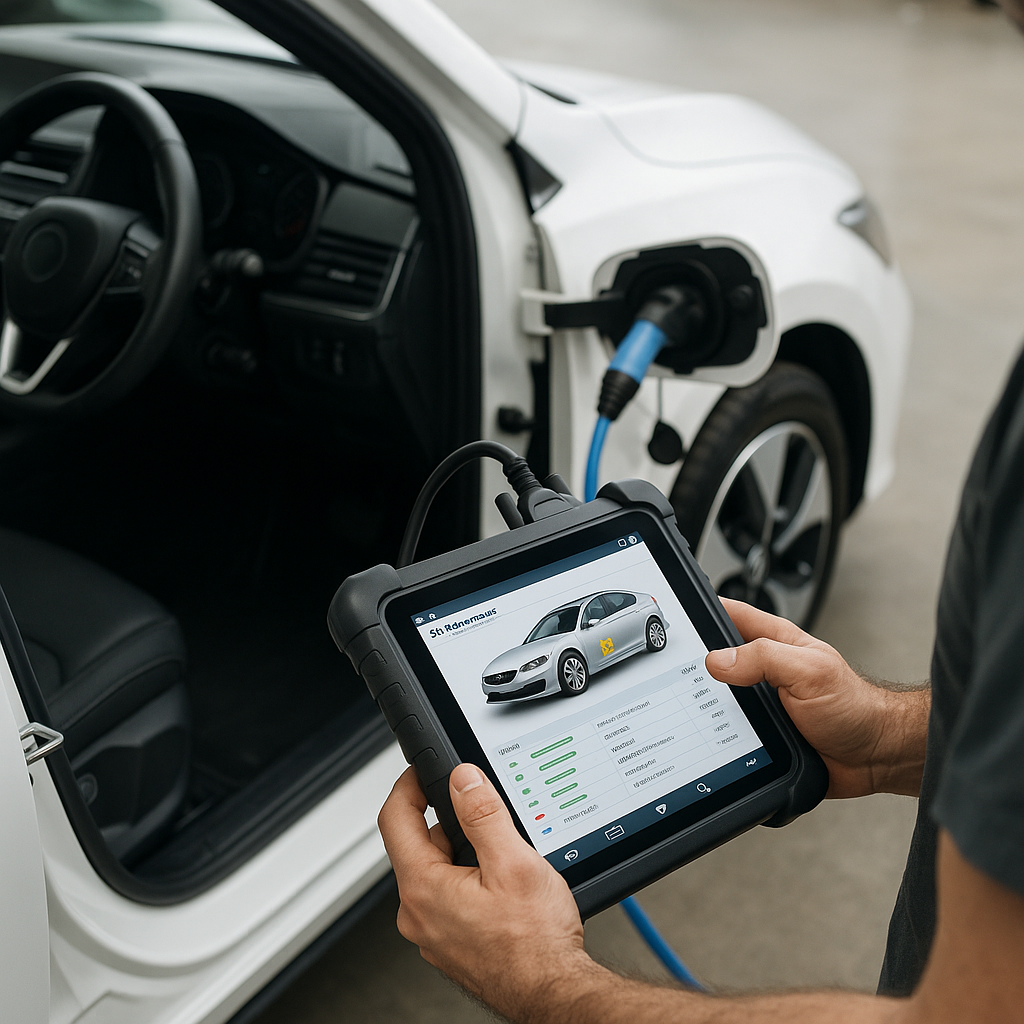
With the scanner in hand, insert the connector into the OBD-II port firmly until you feel a secure fit. If your scanner uses Bluetooth connection, this is the time to pair the device with your smartphone or tablet via your phone’s Bluetooth settings. Check that the corresponding app is installed and updated before trying to establish the connection. Some modern scanners include a rechargeable internal battery, while others feed through the OBD-II port when connected.
After successful connection, turn on the car in accessory mode (usually you turn the key or press the start button without stepping on the accelerator pedal). The scanner will wait a few seconds to establish communication with the vehicle modules.You will see a series of data on the screen, including information about the current state of the car, active error codes or fault history. If the scanner is unable to connect, check that the car battery is charged enough and try again.
To read the data in real time, navigate to the option of “Live Data” or “Data Stream” in the menu of the application or device. In this section, you will see constantly updated parameters such as battery voltage, electric motor temperature, regeneration efficiency and power consumption. You can select which parameters you want to view, making the experience more personalized to your specific needs. If you are diagnosing a particular problem, focus on the parameters related to the problematic system.
Interpreting Error Codes on Electric and Hybrid Cars
Error codes on electric cars follow the DTC (Diagnostic Trouble Code) standard, but include specific categories related to the unique systems of these vehicles. Codes starting with “P” refer to engine and powertrain problems, “C” indicate body and chassis problems, “B” point to corporate and integrity problems, while “U” signal network and communication problems between modules.Your scanner will provide a detailed description of each code, but understanding this basic categorization helps you contextualize the problem.
For specific electric car systems, you can find codes related to battery management, indicating problems such as cell imbalance, overheating or failure in the battery cooling system. Power inverter codes indicate problems in the power conversion between AC and DC. Charging system problems appear as specific codes of the integrated charging unit. Always write down the exact code and look for specific references for your car model to get the most accurate interpretation.
Some codes require immediate attention, such as those related to battery safety or regenerative braking system, while others can wait for the next scheduled maintenance service.Your scanner often categorizes the severity of the problem, indicating whether it is critical, warning or just informative.Do not ignore error codes even if the car appears to be running normally, as electrical problems can develop quickly and become dangerous or too expensive to repair.
Advanced Features and Customizations for Experienced Users
If you are an enthusiast or experienced technician, many modern scanners allow advanced adjustments such as modification of calibration parameters, remote key programming and even reprogramming of electronic modules. These features require considerable technical knowledge and should be used with caution, as an incorrect configuration can damage expensive components.Always consult technical manuals or seek professional guidance before attempting any customization at this level.
Data recording (data logging) is a powerful feature that allows you to capture sequences of events over an extended period. You can drive your car normally while the scanner records all parameters in real time, creating a history file that can be analyzed later. This feature is especially useful for diagnosing intermittent problems that do not occur consistently, allowing you to identify patterns and correlations between events that lead to failures.
Some scanners include energy efficiency analysis, showing how your car is consuming energy in different driving conditions.You can compare current efficiency with historical data to detect gradual degradation in components such as the electric motor or the battery. This type of preventive monitoring is especially valuable in hybrid cars, where you can optimize the use of the combustion engine versus the electric motor for maximum economy.
Preventive Maintenance Using Scanner Data
One of the biggest benefits of owning an automotive scanner is the ability to perform preventive maintenance before problems cause catastrophic failures. By regularly monitoring battery health, you can detect early degradation and take action before your car’s range drops significantly.Most electric car manufacturers expect a 5-10% capacity loss after five years of normal use, but faster degradation can indicate thermal management problems or faulty components.
The temperature of critical systems such as battery, electric motor and inverter is an important indicator of future health.If you notice that these components are regularly operating at higher than normal temperatures, it may mean that refrigeration systems need cleaning or maintenance. Intervening early can prevent premature failures and keep the warranty of expensive components intact.
By understanding your scanner data, you can also optimize your driving habits to extend the life of components. For example, if you notice that regenerative braking has low efficiency in certain scenarios, you can learn to drive more smoothly to maximize energy recovery. Some scanners show consumption statistics by type of trip, allowing you to identify which routes or driving patterns are more efficient and save fuel or electrical energy.
Integrating Your Scanner with Professional Diagnostic Tools
If you use an automotive scanner for professional purposes in a workshop or dealership, integration with more advanced diagnostic systems can significantly increase its efficiency.Many modern scanners allow you to export data to computers or tablets, where you can use specialized software for deeper analysis.You can create documented reports for customers, tracking complete maintenance history and diagnostics performed on each vehicle.
Connectivity with cloud platforms allows you to store data from multiple vehicles and access information from anywhere. Some systems offer automatic alerts when critical parameters enter danger zones, allowing you to notify customers of potential problems before they result in failures. This level of monitoring and documentation is especially important for workshops working with extended warranty or contracted maintenance services.
Integration with technical service bulletin (TSB) and recall databases allows you to quickly verify that a specific error code has been reported as a known issue by the manufacturer. This saves time in research and helps identify whether the problem requires software reprogramming, component replacement, or just calibration adjustments.Many professional scanners include automatic updates of these databases through an internet connection.
Safety and Best Practices when Using Scanners
Always turn off the engine before connecting or disconnecting the scanner from the OBD-II port, as sudden connection during vehicle operation can cause voltage spikes that damage the scanner or the car’s electronic modules. If you are working on diagnostics that require the car to be powered on, make sure that the scanner is fully connected and stabilized before starting the engine. This simple practice prevents many potential problems and prolongs the life of your equipment.
Never attempt to modify software programs or critical safety parameters without fully understanding the implications of these changes. Incorrect modifications may disable safety systems such as airbags, brakes or stability control, putting you and your passengers at serious risk. If you are unsure about a specific scanner function, research or consult a professional before using it. Documenting all actions performed with the scanner is an important safety practice, especially in a professional environment.
Keep your scanner up to date with the latest firmware provided by the manufacturer. Updates often fix bugs, add support for new vehicle models, and improve overall compatibility. Many modern scanners automatically check for availability of updates when connected to the internet. Performing these updates regularly ensures that you have access to the latest features and security fixes.
Practical Use Cases: Real Problems Solved with Scanners
Consider a scenario where you own a hybrid car and start to notice that the combustion engine is no longer shutting down at prolonged stops as it should. A scanner would reveal error codes related to the engine management system or the battery charging system. With this information, you can determine whether the problem is a low-charged battery that fires the engine to maintain charge, or whether there is a problem with the regenerative braking system that prevents proper charging.
Another common scenario involves an electric car displaying the battery warning light on the dashboard, but you need to know whether it is a critical problem or a false alarm. Using a scanner, you can read the exact health of the battery, check the temperature of the individual modules and determine whether there is an imbalance of cells. This type of detailed diagnosis allows you to make informed decisions about whether you need to repair immediately or can continue using the car normally.
A third example involves diagnosing gradual reduction of range in an electric car. A scanner can track changes in regeneration efficiency, battery cell degradation, increased friction in the engine, or even problems with wheel alignment that increase resistance.By reviewing historical data collected over weeks, you can identify the culprit and take corrective action before the problem becomes critical.
Alternatives and Add-ons to Traditional Scanner
In addition to conventional scanners, there are other tools and applications that can complement your ability to diagnose electric and hybrid cars. Many brands of electric vehicles include official smartphone apps that provide basic diagnostic information such as battery status, charging history, and maintenance reminders.
Specialized battery analyzers offer deep analysis focused specifically on battery health and performance, a critical component in electric cars. These devices can measure actual capacity, internal resistance, cell imbalance degrees, and remaining life prognosis.If battery health is your main concern, a specialized tool can provide deeper insights than a general scanner.Many professional workshops invest in both tools to provide complete diagnosis to customers.
Energy efficiency analysis software provides a different perspective on the performance of your car. While a scanner offers raw technical data, specialized software can process this data to generate graphical visualizations, comparisons with factory baselines, and optimization recommendations.Some solutions integrate GPS location data for route type consumption analysis, helping you identify ways to improve overall efficiency.
Financial Investment and Long-Term Return
Automotive scanners vary dramatically in price, from basic models costingReal scenes to professional devices costing thousands of dollars. A basic scanner for reading error codes may be sufficient if you just want to understand why a warning light has turned on on the panel.But if you plan to use the device regularly for advanced diagnosis, preventive maintenance or professional work, investing in a more robust model with more features is usually more cost effective in the long run.
The return on investment in a scanner appears quickly when you consider the cost of professional diagnostics. A simple error code reading at a dealership can cost 50 to 100 reais or more, depending on the brand. If you need to diagnose your car only three or four times a year, a medium-quality scanner will pay for itself in a few uses. In addition, access to detailed data allows you to make informed decisions about repairs, avoiding unnecessary interventions that cost hundreds or thousands of dollars.
Multi-vehicle owners especially benefit from investing in a quality multi-brand scanner.You can diagnose problems in any car you own, significantly reducing maintenance expenses over time. Professionals such as independent mechanics or workshop technicians have even faster financial return as they can charge for diagnostic services and offer preventive maintenance based on hard data from the scanner.
Future Trends in Electric Car Diagnostics
The automotive industry is rapidly evolving towards increased connectivity and remote diagnostics.Many modern electric cars can send diagnostic data directly to the manufacturer’s servers, allowing predictive analysis of potential failures.Scanners of the future will likely integrate artificial intelligence to recognize patterns and predict problems before they cause noticeable failures.
Augmented reality (AR) is beginning to appear in diagnostic tools, allowing technicians to intuitively visualize complex systems superimposed on the actual image of the car. Imagine pointing your scanner at a car and instantly seeing the location of all sensors, actuators and electronic modules, with real-time data displayed side by side with maintenance recommendations. This technology will make diagnosis significantly more accessible even to owners without technical experience.
Increased standardization of diagnostic protocols in electric cars should happen in the coming years as privacy and safety regulations become stricter.This means that scanners of the future will be able to offer even broader compatibility between manufacturers, reducing the need for multiple specialized tools. You will also see deeper integration between scanners and vehicle safety systems, allowing for more complete diagnosis without the need for additional tools.